
After working through identification, marking, scoping, implementation, assessment, and enhanced requirements, the final step is consolidation. This post brings everything together into a single, actionable CUI compliance checklist aligned with real contract requirements and reporting obligations.
This wrap-up serves as both a summary of the CUI Compliance Series and a practical resource you can use to track and demonstrate compliance across your organization.
Step 7 Goal: Align the CUI Compliance Checklist with Contract Requirements
A complete CUI compliance checklist must go beyond internal controls. It must align with contractual obligations, particularly those defined in DFARS 252.204-7012.
DFARS 252.204-7012 requires that covered contractor information systems implement the security requirements in NIST SP 800-171 in effect at the time of contract award, unless otherwise directed by the Contracting Officer. This requirement anchors your compliance program to enforceable contract language, not just best practices.
The clause also defines incident response expectations. Organizations must rapidly report cyber incidents within 72 hours of discovery, preserve affected systems and relevant data, and maintain that data for at least 90 days following submission of the report.
These requirements make it clear that a CUI compliance checklist must include not only preventative controls, but also detection, reporting, and evidence preservation capabilities.
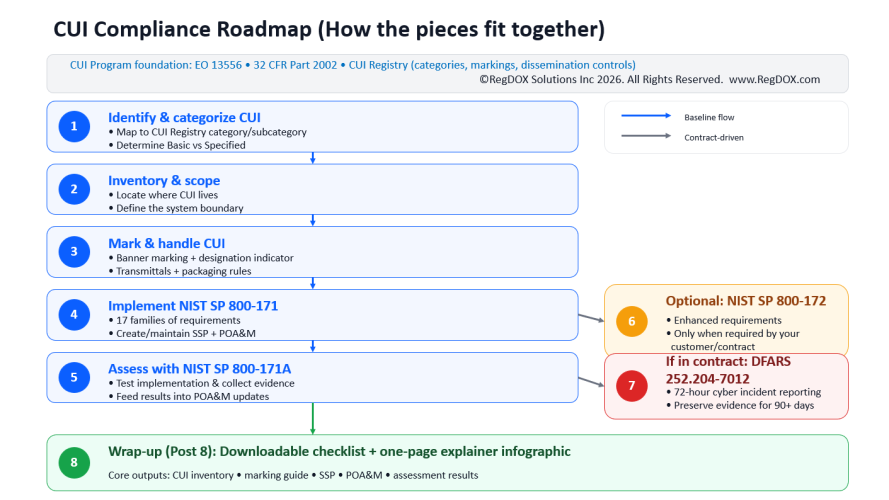
The Complete CUI Compliance Checklist
At a high level, a defensible CUI compliance checklist follows a structured sequence that builds on each prior step:
- First, organizations must identify whether information qualifies as CUI and maps it to the appropriate category in the CUI Registry. This establishes the foundation for all downstream controls.
- Next, CUI must be properly marked using authorized markings, ensuring that all authorized holders can recognize and handle the information correctly.
- From there, organizations define the CUI system boundary by identifying where CUI is processed, stored, or transmitted. This step determines the scope of compliance.
- Once scoped, organizations implement the required security controls using NIST SP 800-171 as the baseline framework. These controls must then be assessed using NIST SP 800-171A to confirm they are implemented correctly and operating as intended.
- If required by contract, NIST SP 800-172 requirements are applied as an additional layer to address advanced threats.
- Finally, organizations must ensure that contractual obligations, including DFARS reporting requirements, are fully integrated into their compliance program.
Complete this form to receive the CUI Compliance Checklist by email
CUI Compliance Flow: Identify → Mark → Scope → Implement → Assess → Enhance (if required) → Contract and Report
Why a CUI Compliance Checklist Matters
Without a structured checklist, organizations often approach compliance in a fragmented way. Controls may be implemented but not documented. Systems may be secured, but not properly scoped. Requirements may be understood but not contractually aligned.
A well-defined CUI compliance checklist eliminates these gaps by providing a repeatable, defensible framework. It ensures that each step builds on the previous one and that nothing critical is overlooked.
This is especially important in audit scenarios, contract reviews, and incident response situations, where organizations must demonstrate not just intent, but execution.
Final Perspective
CUI compliance is not a single control or a one-time effort. It is a structured process that connects regulatory requirements, system implementation, and contractual obligations into a unified program.
By using a comprehensive CUI compliance checklist, organizations can move from reactive compliance to a proactive, defensible security posture that aligns with federal expectations.
About RegDOX
At RegDOX Solutions Inc., we help defense contractors and high-security organizations simplify compliance with ITAR, EAR, DFARS, and CMMC requirements. Our secure, cloud-based platforms combine end-to-end encryption, access controls, and audit-ready documentation to keep your data—and your contracts—safe.
Need help navigating evolving cybersecurity regulations?
Request a Compliance Demo
Or contact us directly at info@regdox.com
See the enclave in action.
The Compliant Computing Enclave keeps CUI inside one boundary, with your endpoints out of scope and the evidence trail already built.
Talk to an Expert →