ITAR is being deliberately loosened for speed. Looser licensing does not mean less compliance work. It shifts the burden onto you: controlling access, honoring exemption conditions, and proving all of it. RegDOX built the first ITAR-compliant cloud collaboration platform in 2015, and it was built for exactly this moment.
The International Traffic in Arms Regulations, 22 CFR Parts 120 through 130, are administered by the State Department's Directorate of Defense Trade Controls. They govern defense articles and defense services on the U.S. Munitions List, and critically, the technical data behind them: drawings, specifications, blueprints, software, and documentation.
If your company manufactures, exports, or brokers defense articles or their technical data, ITAR applies. You register with DDTC, you control who can access the data, and you keep the records that prove it. And "export" is broader than shipping: showing technical data to a foreign person is a deemed export, even inside the United States, even over email or a shared drive.
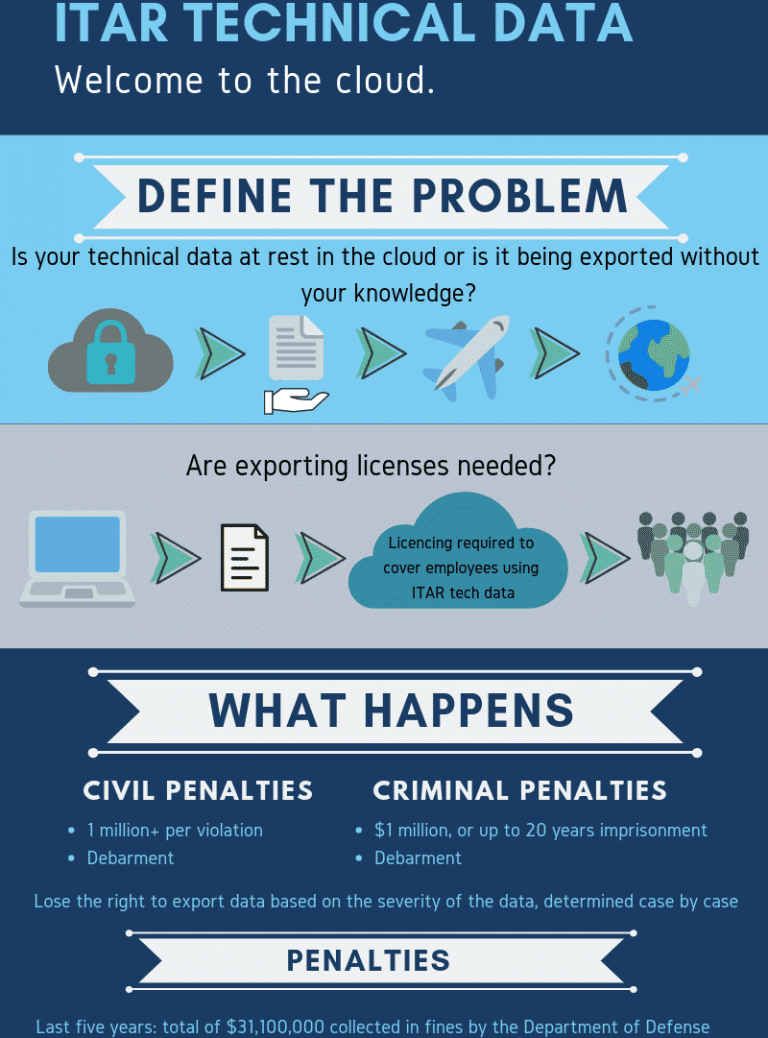
The stakes are not abstract. Civil penalties run into the millions per consent agreement, willful violations carry criminal exposure, and debarment ends defense revenue outright. The enforcement record below shows exactly where companies get hurt.
For the part of ITAR that lives on your systems, your technical data, the SDR delivers the controlled enclave the regulation demands: U.S.-only hosting and personnel, access restricted to authorized U.S. Persons on need-to-know, deemed exports architecturally prevented, encryption satisfying §120.54, five-year recordkeeping enforced, and a tamper-proof audit trail that proves all of it on demand.
Registration, classification, and licensing remain your program. The Secure Data Room is the platform that makes them provable. Reviewed by the State Department's DDTC.
The Munitions List runs 21 categories, from firearms and ordnance to launch vehicles, military electronics, and spacecraft. Anyone who manufactures, exports, or brokers listed articles or their technical data complies, and that net is wider than most people think:
And here is the part that surprises people: there is no ITAR certification. No certificate, no seal, no audit that settles it. Compliance is your internal controls and what you can document, which means the question is never "are you certified." It is "what can you prove."
Executive Order 14268 kicked off the biggest deliberate loosening of defense-trade licensing in years, reinforced in 2026 by the America First Arms Transfer Strategy. Licenses move faster. Exemptions open wider. The government is stepping back from pre-approval gatekeeping.
What it is not stepping back from is accountability. Responsibility for restricting access, meeting exemption conditions, and proving both now sits with the exporter. A controlled, auditable home for technical data matters more under deregulation, not less.
Most companies have not connected those dots yet. The ones that do will move faster than their competitors and sleep better than them too.
Recent consent agreements tell one consistent story: technical-data control, classification accuracy, and recordkeeping are where companies get hurt.
Documents with layouts, dimensions, and geometries qualified as ITAR technical data. Prior deficiencies went unfixed, and the violations recurred.
A single incorrect jurisdiction self-determination on software cascaded into 24 alleged violations, including exports to proscribed destinations.
The consent decree required an automated export compliance system: electronic controls, tracking, and real-time auditing of technical data.
Transactions were not tracked and the information was not preserved. The recordkeeping failure was itself an ITAR violation.
The through-line: the control, tracking, and auditing functions DDTC has required as remedies are the functions a purpose-built secure data room provides before there is ever a problem.
Effective December 30, 2025, ITAR §126.7 created a license-free channel for defense trade among Australia, the United Kingdom, and the United States. Over 700 Australian and UK entities are already Authorized Users. It is a genuine growth opening, and it is conditional.
Every condition on the left is an access-control and recordkeeping problem. That is what a purpose-built Secure Data Room does: scope a room to Authorized Users only, enforce it at the platform, and produce the audit trail showing that is who touched it.
For companies already working with UK and Australian partners, this converts a defensive control into a growth unlock: collaborate license-free where the exemption allows, with the eligibility evidence generated as a byproduct of doing the work.
The RegDOX Secure Data Room is built to support exactly that.
The ITAR requires records of the manufacture, acquisition, and disposition of defense articles, including technical data, kept for five years. Failing to maintain or produce them is itself a violation, independent of any export issue.
DDTC is generally lenient with companies that come clean with complete records and remediation that works. A point-in-time archive report reconstructs exactly what a specific user could see at a specific time.
Under §120.54, properly end-to-end-encrypted data isn't an export event. But ITAR technical data is also Level 4 CUI, which demands restricting access by user and by location. Encrypted in transit is table stakes. Controlling where and by whom is the differentiator.
DDTC's 2026 agenda signals USML revisions for space, semiconductors, and defense services. When items move on or off the list, technical data gets re-scoped. A controlled room makes that a permissions change, not a migration.
RegDOX redefined how controlled documents are handled in the cloud, and has served some of the largest companies in North America ever since. This is not a bolt-on feature. It is the company's foundation.
Access restricted to authorized U.S. Persons with need-to-know enforcement means a foreign-person login is not a policy violation waiting to be caught. It is architecturally impossible.
Tamper-proof logs record who touched what, when, from where, with export recording and reporting where transfers are permitted. When State asks, the answer is a report, generated in minutes.
Your technical data is usually CUI too. The same enclave satisfies both obligations, so you run one system instead of two.
Regulatory summaries reflect the public record as of July 2026. Several items, including the Part 130 proposal and the 2026 USML agenda, are proposed rules or agenda items, not final law. This page is not legal advice, and RegDOX does not classify your data or confer certification: it is the compliant home for technical data, plus the evidence layer.
The process we walk with clients, distilled into a checklist your team can work through: classification, the compliance program, DDTC registration, licensing, and the recordkeeping standard that holds up on inspection.
Wherever you are on this list, that is where the conversation starts.
The eight steps above, in a one-page checklist your team can work through and keep.
Three fields. No cost.
Let's review your current defense-trade posture together: where your technical data lives, who can touch it, and what you could prove tomorrow morning if DDTC asked.
(800) 517-3171 · Nashua, NH · U.S. data centers & personnelTalk to an expert
A person who knows the regulation answers. Usually the same business day.
