
Why Ownership Questions Reveal Governance Gaps Sarah was preparing documentation for an upcoming compliance review…
Step 3: CUI Marking Requirements & Checklist (Banner, Portions, Transmittals, Packages)
4.
Step 3: CUI Marking Requirements & Checklist (Banner, Portions, Transmittals, Packages)
CUI marking errors are one of the most common and most preventable sources of compliance risk. Even when organizations correctly identify CUI and scope their systems, inconsistent or incorrect markings can undermine handling controls and create downstream confusion. Step 3 focuses on translating regulatory requirements into markings that can be applied consistently and enforced operationally.
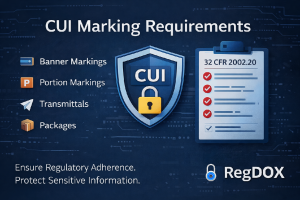
This post covers Step 3 of the CUI Compliance Series: understanding and implementing CUI marking requirements based on 32 CFR 2002.20 and the CUI Registry.
Step 3 Goal: Apply CUI Marking Requirements Consistently
Federal regulation makes clear that the CUI markings listed in the CUI Registry are the only markings authorized to designate Controlled Unclassified Information (CUI) that requires safeguarding or dissemination controls. Consistency is not optional. Markings must be applied uniformly across organizations, including the Defense Industrial Base.
The goal of Step 3 is to ensure that CUI is clearly and correctly marked so authorized holders can recognize it, handle it appropriately, and avoid accidental misuse or disclosure.
Core CUI Marking Requirements You Can Enforce Consistently
The regulation establishes several foundational rules that form the baseline for any CUI marking program. Every CUI document must include a banner marking that contains a mandatory CUI control marking. The control marking must be either “CUI” or “CONTROLLED,” as specified in the CUI Registry.
The regulation also makes clear that the absence of a CUI marking does not remove handling obligations. Authorized holders are still required to protect CUI even if it was not properly marked, which makes proactive and consistent marking critical. For CUI Specified, category or subcategory markings must appear in the banner marking when they apply. These markings are mandatory when the authorizing authority includes specific handling or dissemination requirements.
For a visual overview of how these banner markings and control markings are applied in practice, the National Archives provides an Intro to CUI Marking Guide on archives.gov that many teams find useful when standardizing document templates and workflows.
Designation Indicator: A Small Marking That Is Often Missed
In addition to the banner marking, the regulation requires a designation indicator. This indicator must be readily apparent to authorized holders and may appear only on the first page or cover of the document.
Although simple, this requirement is frequently overlooked, especially in templates and automated document generation workflows. Ensuring the designation indicator is present and visible is an important part of meeting CUI marking requirements.
Portion Marking: Permitted, Encouraged, and Controlled
Agencies are permitted and encouraged to apply portion markings to CUI, but only using portion markings that are approved by the CUI Executive Agent and listed in the CUI Registry.
Portion markings help reduce ambiguity in mixed-content documents, but they must remain consistent with Registry guidance. Improvised or legacy portion markings can create confusion and should be avoided.
Packages, Parcels, and Transmittals: Small Rules with Big Consequences
Some of the most overlooked CUI marking requirements apply to physical and electronic delivery.
The regulation requires that packages containing CUI be addressed for delivery only to a specific recipient. At the same time, it explicitly prohibits placing CUI markings on the outside of envelopes or packages.
When a transmittal document accompanies CUI, the transmittal itself must include a CUI marking indicating that CUI is attached or enclosed. It must also include handling instructions that explain what remains once the enclosure is removed. These rules apply even when the transmittal does not otherwise contain CUI content.
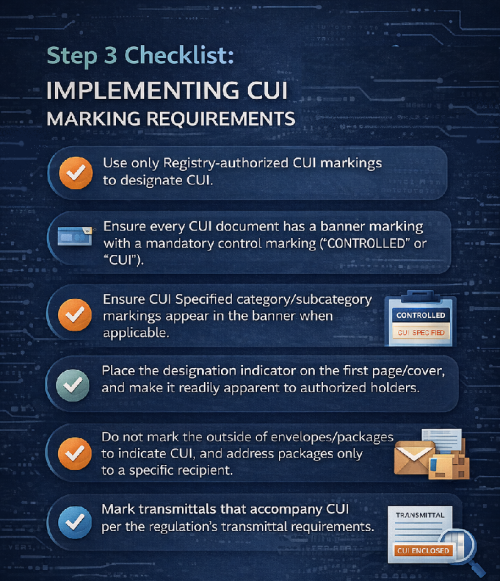
Step 3 Checklist: Implementing CUI Marking Requirements
A practical Step 3 implementation should ensure that:
- Use only Registry-authorized CUI markings to designate CUI.
- Ensure every CUI document has a banner marking with a mandatory control marking (“CONTROLLED” or “CUI”).
- Ensure CUI Specified category/subcategory markings appear in the banner when applicable.
- Place the designation indicator on the first page/cover, and make it readily apparent to authorized holders.
- Do not mark the outside of envelopes/packages to indicate CUI, and address packages only to a specific recipient.
- Mark transmittals that accompany CUI per the regulation’s transmittal requirements.\
Why CUI Marking Requirements Matter Operationally
Markings are the interface between policy and daily operations. If markings are inconsistent, incomplete, or improvised, even well-designed handling controls break down in practice.
By enforcing standardized CUI marking requirements early, organizations reduce confusion for authorized holders, support downstream access and handling controls, and create a more defensible compliance posture.
Up Next: Step 4, Implementing NIST SP 800-171
The next entry in the series is Step 4: implementing NIST SP 800-171 and documenting what you did. Once CUI is properly identified, scoped, and marked, the focus shifts to implementing and documenting the security controls that protect it.
About RegDOX
At RegDOX Solutions Inc., we help defense contractors and high-security organizations simplify compliance with ITAR, EAR, DFARS, and CMMC requirements. Our secure, cloud-based platforms combine end-to-end encryption, access controls, and audit-ready documentation to keep your data—and your contracts—safe.
Need help navigating evolving cybersecurity regulations?
Request a Compliance Demo
Or contact us directly at info@regdox.com
Click to rate this post!
[Total: 0 Average: 0]
Related Posts

This Post Has 0 Comments