
Why Ownership Questions Reveal Governance Gaps Sarah was preparing documentation for an upcoming compliance review…
CUI Compliance: NIST SP 800-171 & 800-172 (7-Step Series)
1.
CUI Compliance: NIST SP 800-171 & 800-172 (7-Step Series)
Controlled Unclassified Information (CUI) is a federally defined information category managed under an executive branch cybersecurity program established by Executive Order 13556 and implemented through 32 CFR Part 2002. Effective CUI compliance depends on two fundamentals: recognizing CUI and handling it correctly across people, processes, and technology.
This eight-part blog series is designed for both experienced CUI handlers and teams that are new to CUI. It focuses on CUI program fundamentals, including categories, dissemination, and marking, and the high-level requirements for safeguarding CUI confidentiality in nonfederal systems using NIST SP 800-171 and, when applicable, NIST SP 800-172.
CUI compliance in 60 seconds
If you need a simple way to think about CUI compliance, it typically comes down to:
- determine whether information is CUI and what category it falls under
- define where CUI is processed, stored, or transmitted (your system boundary)
- apply correct markings and handling rules
- implement NIST SP 800-171 controls and document them
- assess using NIST SP 800-171A
- apply NIST SP 800-172 enhanced protections when required
This series is the step-by-step guide behind that workflow.
What this CUI compliance series is (and isn’t)
Let’s start with what it is: a practical, structured CUI compliance checklist series with clear, step-by-step guidance you can follow to build and operate a defensible CUI program, especially in environments where NIST SP 800-171 applies.
What it isn’t: a replacement for contract interpretation or customer direction. In practice, CUI handling requirements and assessment expectations are often contract-driven and can vary by program, flow-downs, and audit posture. This series provides a repeatable, documentation-friendly method to make supportable decisions, document the “why” behind them, and reduce avoidable compliance gaps over time.
Why CUI compliance matters (EO 13556 and 32 CFR Part 2002)
CUI is not just a labeling exercise. It is a government-wide approach to identifying and protecting sensitive information that does not meet classification thresholds but still requires safeguarding. When CUI is handled in nonfederal systems, for example contractor or supplier environments, CUI compliance often becomes a combination of:
- program rules, including categories, dissemination, and marking
- cybersecurity safeguards, primarily NIST SP 800-171, and sometimes NIST SP 800-172
Organizations that struggle most tend to skip steps early, especially around scoping (system boundary) and marking, and then try to fix it later with tooling. This series is structured to prevent that pattern.
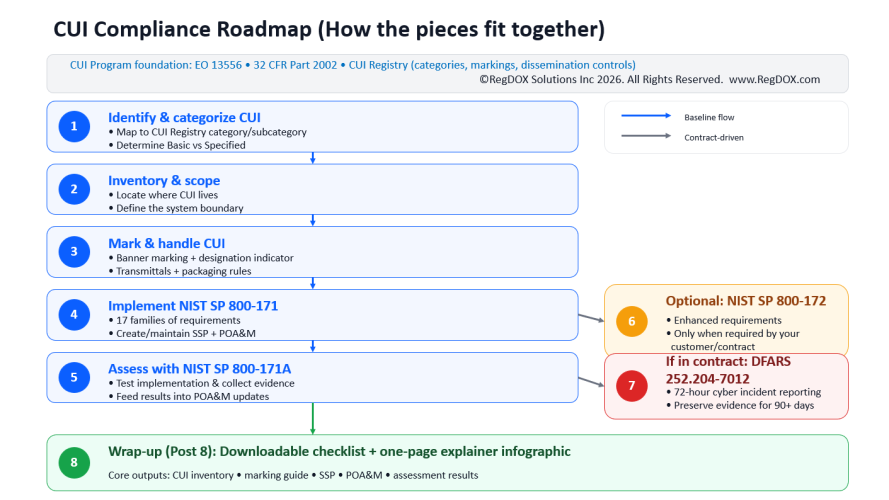
The CUI compliance roadmap: the next 7 posts (Step-by-step)
- Step 1: Identify whether the information is CUI and map it to the CUI Registry category/subcategory and any “CUI Basic” vs “CUI Specified” handling.
- Step 2: Build a CUI inventory and define the system boundary (what systems/processes actually process/store/transmit CUI), as well as those outside the system boundary and potentially or clearly non-compliant.
- Step 3: Get CUI markings right (banner marking, designation indicator, transmittals, packages/parcels, portion marking, and decontrol indicators).
- Step 4: Implement NIST SP 800-171 (and document it via SSP/POA&M).
- Step 5: Assess your implementation using NIST SP 800-171A assessment procedures.
- Step 6: Determine whether NIST SP 800-172 enhanced requirements are needed (and how they’re used).
- Step 7: (Wrap-up) Contract and flow-down reality checks + incident response/reporting (plus the promised downloadable checklist and an explanatory infographic).
Quick start: three anchor sources for CUI compliance
Throughout your use of this and the upcoming blog entries and, more broadly, your use, custody and control of CUI, the following publications are the foundational tools and requirement for defining CUI and maintaining program compliance:
- The CUI Registry – The regulation describes the Registry as the authoritative central repository for CUI guidance (other than the Order and 32 CFR Part 2002) and is publicly accessible. (Link to CUI Registry)
- NIST SP 800-171 – Provides recommended security requirements for protecting CUI confidentiality when CUI resides in nonfederal systems and organizations. (Link to NIST SP 800-171r3)
- NIST SP 800-172 – Provides enhanced security requirements intended to supplement SP 800-171 in response to the advanced persistent threat (APT). (Link to NIST SP 800-172)
Up next: Step 1: Is it CUI? (and how to prove it)
Next in the series is Post 2, Step 1: Is it CUI? (and how to prove it). We will walk through a defensible method to determine whether information is CUI, map it to the CUI Registry, and document the decision so it holds up during audits, customer reviews, and internal governance.
About RegDOX
At RegDOX Solutions Inc., we help defense contractors and high-security organizations simplify compliance with ITAR, EAR, DFARS, and CMMC requirements. Our secure, cloud-based platforms combine end-to-end encryption, access controls, and audit-ready documentation to keep your data—and your contracts—safe.
Need help navigating evolving cybersecurity regulations?
Request a Compliance Demo
Or contact us directly at info@regdox.com
Click to rate this post!
[Total: 0 Average: 0]
Related Posts

This Post Has 0 Comments