
Why Procurement Decisions Shape Long-Term Compliance
Sarah had spent weeks helping leadership define architectural standards and establish clear ownership across the organization’s CUI environment. Just as those conversations began to align, procurement introduced a new challenge:
“How do we compare vendors?“
In this example scenario, the evaluation checklist quickly filled with familiar items: encryption, access controls, secure storage, logging, application support, and workspace access. On paper, every platform appeared to meet the technical criteria.
But the comparison overlooked the question that mattered most. The organization wasn’t simply choosing software, it was choosing the compliance operating model that would govern how CUI would be protected, administered, and maintained for years to come. In many cases, that decision has a far greater impact on long-term compliance than the feature checklist itself.
Why a Compliance Operating Model Matters
By the time an organization formally shops for a CUI solution, they often already know the technical features they want.
- Secure storage
- Access control
- Encryption
- Logging
- Workspace access
- Application hosting
Those capabilities are important, but they are not enough to guide a sound purchasing decision.
The better question is broader:
Are we buying a tool, or are we investing in a compliance operating model?
A tool may satisfy a narrow technical requirement. A compliance operating model supports the complete lifecycle of controlled work, including administration, evidence collection, change management, and operational continuity.
What a Mature Compliance Operating Model Looks Like
The materials behind the CCE case study point toward the second category.
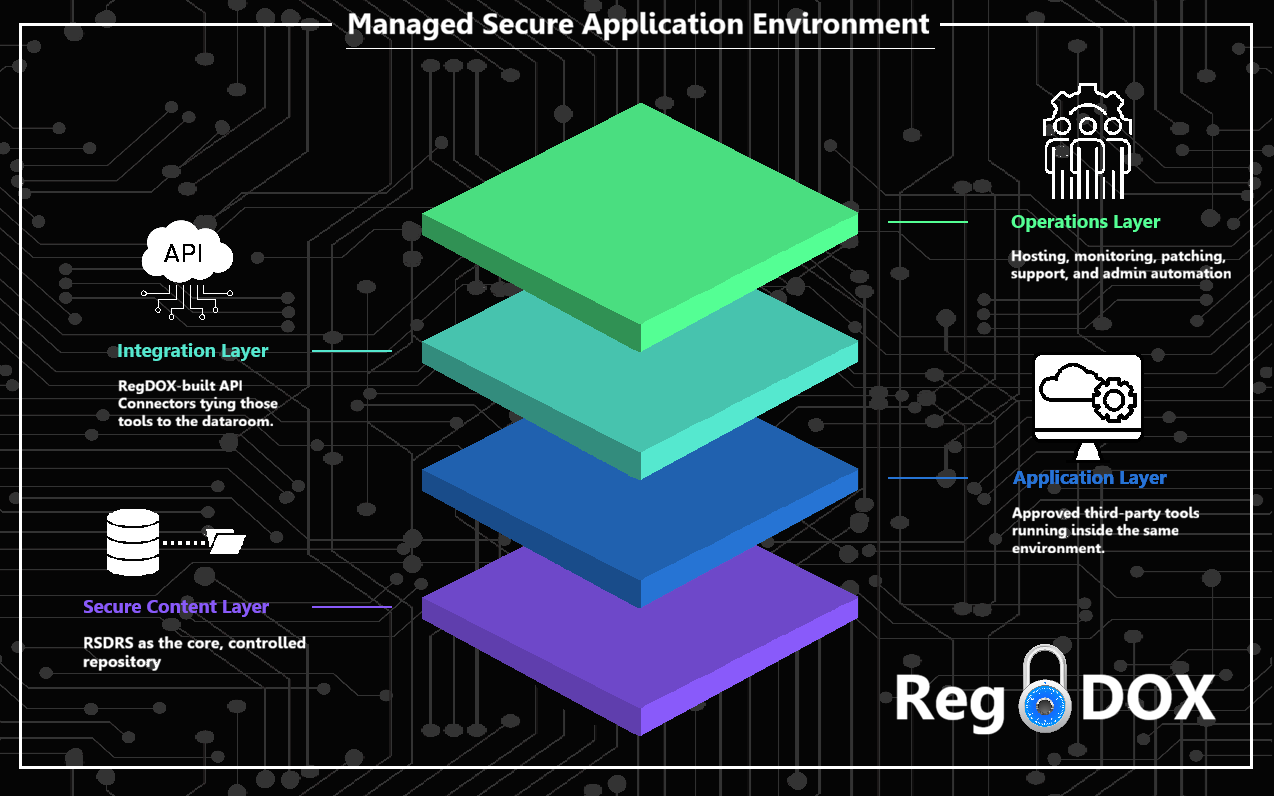
Rather than delivering isolated features, the architecture combines:
- A secure content layer
- Approved applications operating within the same environment
- Managed API connectors
- Centralized administration
- Controlled workspace access
- Ongoing operational support
That combination is what makes the environment valuable.
The strength of a compliance operating model is not found in any individual capability. It comes from the way those capabilities work together to support secure operations throughout the CUI lifecycle.
See What a Compliance Operating Model Looks Like
A compliance operating model is more than a collection of security features. It is a unified approach to protecting, governing, and managing CUI throughout its lifecycle. Explore how the RegDOX Compliant Cloud Environment (CCE) brings these capabilities together in a single architecture.
Discover how a unified environment supports secure, compliant CUI operations.
Why Architecture Influences Procurement
Industry guidance reinforces this perspective. NIST SP 800-171 Rev. 3 applies to systems that process, store, transmit, or protect CUI. Likewise, DoD Level 3 scoping guidance emphasizes the importance of clearly defining assessment scope and demonstrates how workspace architecture can influence what falls inside that boundary. Together, these sources point to an important procurement lesson:
Architecture decisions directly influence compliance costs, evidence quality, operational resilience, and long-term maintainability.
Selecting a compliance operating model is ultimately an architectural decision, not simply a software purchase.
Questions Every Procurement Team Should Ask
This should influence how executives and sourcing teams evaluate potential solutions.
Rather than comparing feature lists alone, ask vendors questions such as:
- How does CUI remain inside the protected environment during editing, review, and transformation?
- How is assessment scope controlled?
- How are users offboarded?
- How are reports generated across the entire environment?
- Who owns platform maintenance and integration stability?
If those answers come back as separate product brochures, the compliance operating model is probably weak.
Buy an Operating Model, Not Just a Platform
The right platform should help an organization work, govern, and demonstrate control through a single, integrated design.
Technology will continue to evolve, and compliance requirements will continue to mature. But organizations that invest in a strong compliance operating model are better positioned to adapt because their governance, operations, and technical controls are designed to function together rather than as disconnected components.
Call to action: Rewrite your solution evaluation criteria so every feature is tied to a lifecycle question. If a feature does not strengthen the operating model, it should not lead to a purchase.
About RegDOX
At RegDOX Solutions Inc., we help defense contractors and high-security organizations simplify compliance with ITAR, EAR, DFARS, and CMMC requirements. Our secure, cloud-based platforms combine end-to-end encryption, access controls, and audit-ready documentation to keep your data—and your contracts—safe.
Need help navigating evolving cybersecurity regulations?
Request a Compliance Demo
Or contact us directly at info@regdox.com
See the enclave in action.
The Compliant Computing Enclave keeps CUI inside one boundary, with your endpoints out of scope and the evidence trail already built.
Talk to an Expert →