
Why the CUI Boundary Breaks Down in Real-World Workflows
For many defense contractors, CUI compliance still breaks down at the exact point where the CUI boundary is weakest, where the real work begins. A file may start inside a secure repository, but the moment it is downloaded for editing, routed through email, copied into a helper application, or handled on an unmanaged endpoint, the CUI boundary begins to weaken. That gap matters because protecting Controlled Unclassified Information (CUI) is not only about storage: it is about the systems that process, store, transmit, and protect data throughout its lifecycle within a clearly defined and enforced boundary.
What NIST 800-171 Requires for a Defensible CUI Boundary
NIST SP 800-171 Rev. 3 makes that point clear. Its requirements apply to components of nonfederal systems that process, store, or transmit CUI, as well as components that provide protection for those systems. In other words, the CUI boundary must include every system and process that touches the data. For organizations working toward CMMC Level 2 and, in more demanding cases, CMMC Level 3, this means compliance cannot live in solely policy binders. It has to show up in architecture, access design, auditability, administration, and day-to-day user behavior.
Defining a Controlled and Enforceable Compliance Boundary
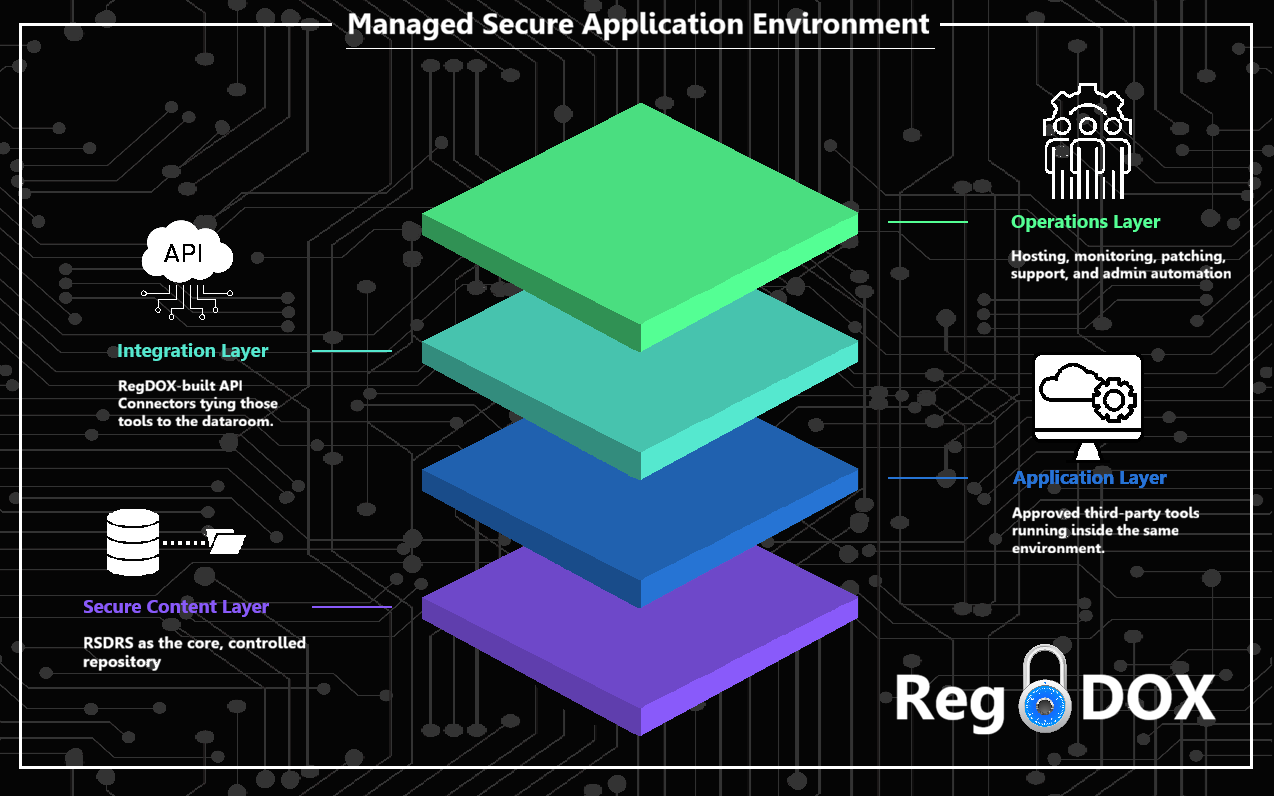
That is why this series focuses on a virtual workspace model such as RegDOX’s Compliant Cloud Environment (CCE). The case for this model is straightforward. When storage, applications, connectors, administration, and monitoring operate within a single managed boundary, organizations reduce the number of locations and instances where CUI can drift out of control. They also gain a more defensible operating model for handling scope, evidence, and accountability.
Over the next thirteen weekly posts, we will examine the compliance problem from the standpoint of executives, compliance leaders, security teams, and procurement decision-makers. We will look at lifecycle control, application sprawl, remote access, offboarding, audit reporting, enclave design, and the added demands that come with Level 3 readiness. We will also examine a practical case study showing what happens when a company replaces a patchwork of tools with a managed secure environment. Each posting will have a call to action for your organization.
If your organization is still trying to protect CUI with a stack of disconnected products, this series is for you. The core question is simple:
Where does your CUI boundary exist, and does it hold when the real work begins?
About RegDOX
At RegDOX Solutions Inc., we help defense contractors and high-security organizations simplify compliance with ITAR, EAR, DFARS, and CMMC requirements. Our secure, cloud-based platforms combine end-to-end encryption, access controls, and audit-ready documentation to keep your data—and your contracts—safe.
Need help navigating evolving cybersecurity regulations?
Request a Compliance Demo
Or contact us directly at info@regdox.com
See the enclave in action.
The Compliant Computing Enclave keeps CUI inside one boundary, with your endpoints out of scope and the evidence trail already built.
Talk to an Expert →