
Introduction
In regulated industries, how you enable remote access is just as important as who you grant it to. This leads many organizations handling sensitive, confidential, or regulated information to ask: how does a browser-accessible Secure Enclave compare to a Virtual Desktop Infrastructure (VDI)? At first glance, both seem similar since each allows remote access to computing resources. Yet, the differences between a Secure Enclave and VDI are significant. These differences influence security, compliance, user experience, and the level of IT resources required to manage them.
This article is the first in a four-part series examining Secure Enclave vs VDI. Referencing RegDOX’s Compliant Cloud Environment (CCE) virtual workplace product, we will highlight what decision-makers should consider when choosing between the two technologies.
- Part 1, we will provide an overview of each technology.
- Part 2 will explore how VDI works, its security model, and management complexity.
- Part 3 will shift focus to Secure Enclaves, with a spotlight on RegDOX’s CCE.
- Part 4 will present a side-by-side comparison of Secure Enclave vs VDI with final recommendations for organizations.
High-Level Overview of VDI vs Browser-Based Secure Enclave
While both solutions provide secure remote access, their foundations differ.
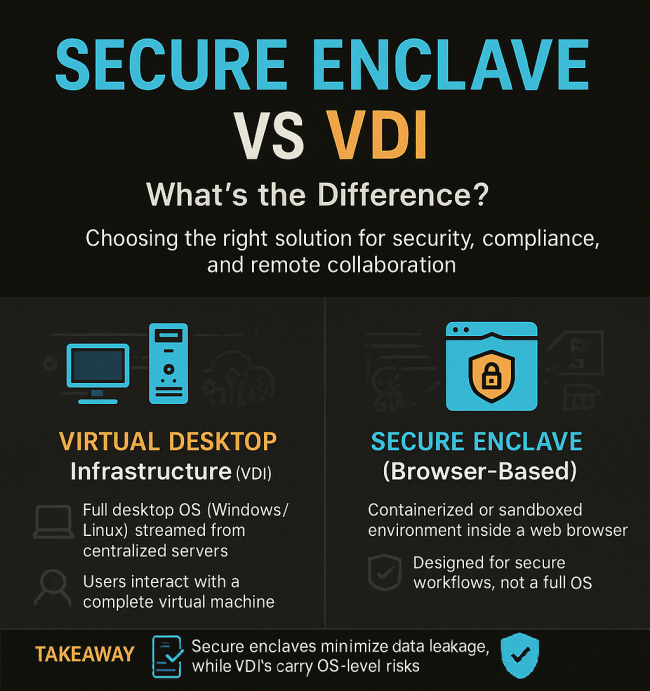
- Virtual Desktop Infrastructure (VDI): A VDI delivers a complete desktop operating system such as Windows or Linux from centralized servers. Users interact with a fully virtualized OS, gaining access to applications, files, and system resources as if they were on a physical desktop.
- Browser-Based Secure Enclave: A Secure Enclave focuses on isolating and protecting sensitive workflows rather than replicating an entire desktop. It leverages a containerized or sandboxed environment that users access directly through standard browsers like Chrome, Firefox, or Edge. Instead of offering a full OS, it provides a tightly controlled, compliance-ready space for document review, file sharing, and collaboration.
This distinction matters. A VDI replicates a traditional desktop, bringing with it complexity and overhead, while a Secure Enclave provides a streamlined, security-first environment designed to reduce risks such as data leakage, unauthorized sharing, or malware intrusion.
Why the Secure Enclave vs VDI Question Matters
Understanding the difference between a Secure Enclave and a VDI is essential for compliance-driven industries such as defense, finance, healthcare, and government. Choosing the wrong approach can lead to unnecessary IT overhead, regulatory gaps, or security vulnerabilities. On the other hand, selecting the right solution can streamline collaboration, protect sensitive information, and ensure compliance with strict regulations.
Coming Up Next
In Part 2 of this series, we will take a closer look at VDI technology, its security model, and the environments where it works best.
About RegDOX
At RegDOX Solutions Inc., we help defense contractors and high-security organizations simplify compliance with ITAR, EAR, DFARS, NIST SP 800-171, and CMMC requirements. Our secure, cloud-based platforms combine end-to-end encryption, access controls, and audit-ready documentation to keep your data—and your contracts—safe.
Need help navigating evolving cybersecurity regulations?
Request a Compliance Demo
Or contact us directly at info@regdox.com
See the enclave in action.
The Compliant Computing Enclave keeps CUI inside one boundary, with your endpoints out of scope and the evidence trail already built.
Talk to an Expert →