
Client Profile
Customer Challenge
The customer faced a complex, multi-layered problem:
Problem: The customer needed a place to store and work with sensitive documents in a CUI-compliant environment rather than using ordinary file-sharing tools.
Problem: The customer needed third-party tools but could not simply let users move files into disconnected external apps.
Problem: A secure data room alone was not enough; the customer needed business workflows that could move content between the data room and other applications without manual downloading and re-uploading.
Problem: The customer did not want to own patching, compatibility testing, hosting-provider coordination, and integration break/fix work for a multi-component secure environment.
Problem: The customer had an administrative sprawl problem: multiple data rooms, repeated user/group changes, and no single place to manage them consistently.
Problem: The customer needed a way to remove users from an environment involving thousands of users, data rooms, and file folders while preserving content ownership and access continuity.
Problem: Permissions had to be changed repeatedly and consistently across many folders, files, and rooms.
Problem: Group structures were inconsistent across rooms or expensive to maintain manually.
Problem: The customer needed audit visibility across all data rooms, not one report at a time, and needed to process files from the secure data room in a specialized document engine without breaking the security boundary.
Problem: Some use cases require users to interact with applications or data in a contained workspace rather than directly on local endpoints.
Problem: The customer had a need for tightly controlled access points for some users who are limited to reaching the environment through a fixed interface rather than a general-purpose workstation setup.
Problem: In a mixed licensing environment, the customer requires clarity on application support.
Bottom line: The customer didn’t just need secure storage; they needed a complete operating environment for sensitive data workflows.
The Solution: RegDOX® Compliant Cloud Environment (CCE)
RegDOX’s (CCE) delivers a managed, secure computing environment designed specifically for CUI workflows:
Solution: The base platform is the RegDOX Secure Data Room Solution (RSDRS) hosted inside the RegDOX CUI Compliant Virtual Workspace. The agreement makes that secure data room the anchor application of the whole solution. Exhibit B then scales it to a large named-user deployment with pooled storage, which suggests the environment is intended for broad organizational use rather than a narrow pilot.
Solution: The agreement provides for third-party software applications to be installed, licensed, and operated inside the same CUI-compliant workspace. RegDOX installs and configures those applications, so they are compatible with the existing CUI environment. Users no longer need to export files into unmanaged, potentially non-compliant systems.
Solution: The agreement adds RegDOX-developed API connectors between RSDRS and approved third-party applications. These connectors can be either licensed from in the RegDOX CCE API connectors library or developed by RegDOX to accommodate each customer’s chosen third-party applications. Those API connectors, whether newly developed or drawn from the RegDOX library, are maintained as integrated components and will remain functional and secure as the software functions comprising the CCE environment change over time.
Solution: RegDOX has responsibility for ongoing maintenance of the secure data room, API connectors, hosting environment, security patches, performance monitoring, and proactive troubleshooting. RegDOX also manages the hosting-provider relationship and provides regular reporting. In practice, that means the solution is not just software delivery; it is a managed secure environment.
Solution: This need was met by the CCE Admin Module integrated into the existing CCE web application to provide centralized configuration across multiple RegDOX data rooms, using existing CCE authentication and shared services. Key design choices include shared authentication, a centralized API account, action logging, batch operations, and a consolidated folder view across data rooms.
Solution: The CCE Admin Module includes a Remove Users function that lists all users with data-room access, lets admins select users for removal, and allows assignment of a substitute owner while reassigning ownership of objects. That directly addresses offboarding and access hygiene without leaving orphaned content.
Solution: The CCE Admin Module includes a feature allowing admins to select group names, modify permissions, and apply changes recursively across folders and files in all data rooms, with rollback support. That addresses both scale and change-control risk.
Solution: The CCE Admin Module adds Remove Groups and Add Groups functions, including creating a group across all data rooms, configuring permissions, and applying those permissions broadly. This is a standardization tool as much as an admin convenience tool.
Solution: The CCE Admin Module allows for consolidated reports and specifically calls for aggregated access-event reporting across all data rooms, with filters and source indicators. It also adds action logging with user, timestamp, and action details. Together, those features address oversight, investigations, and compliance reporting.
Solution: Within the customer’s CCE account, the Secure Web Browser is hosted, supported, licensed, and managed by RegDOX.
Solution: A Virtual Desktop Infrastructure (VDI) has been configured by RegDOX as kiosk-accessible interfaces to the customer’s CCE account. The customer provides the kiosk devices, while RegDOX provides the workspace licensing and support, thereby allowing controlled endpoint access without changing the secure backend architecture.
Solution: CCE allows a customer to separate directly licensed third-party applications from those sublicensed through RegDOX. If the customer licenses software directly, RegDOX mainly helps with integration inside the secure environment. If RegDOX sublicenses it, RegDOX handles ongoing maintenance and support. That structure helps the customer plug in outside tools without confusion about operational ownership.
Result: A unified environment where sensitive data never leaves the compliance boundary.
Compliant Cloud Environment (CCE)
Core Architecture
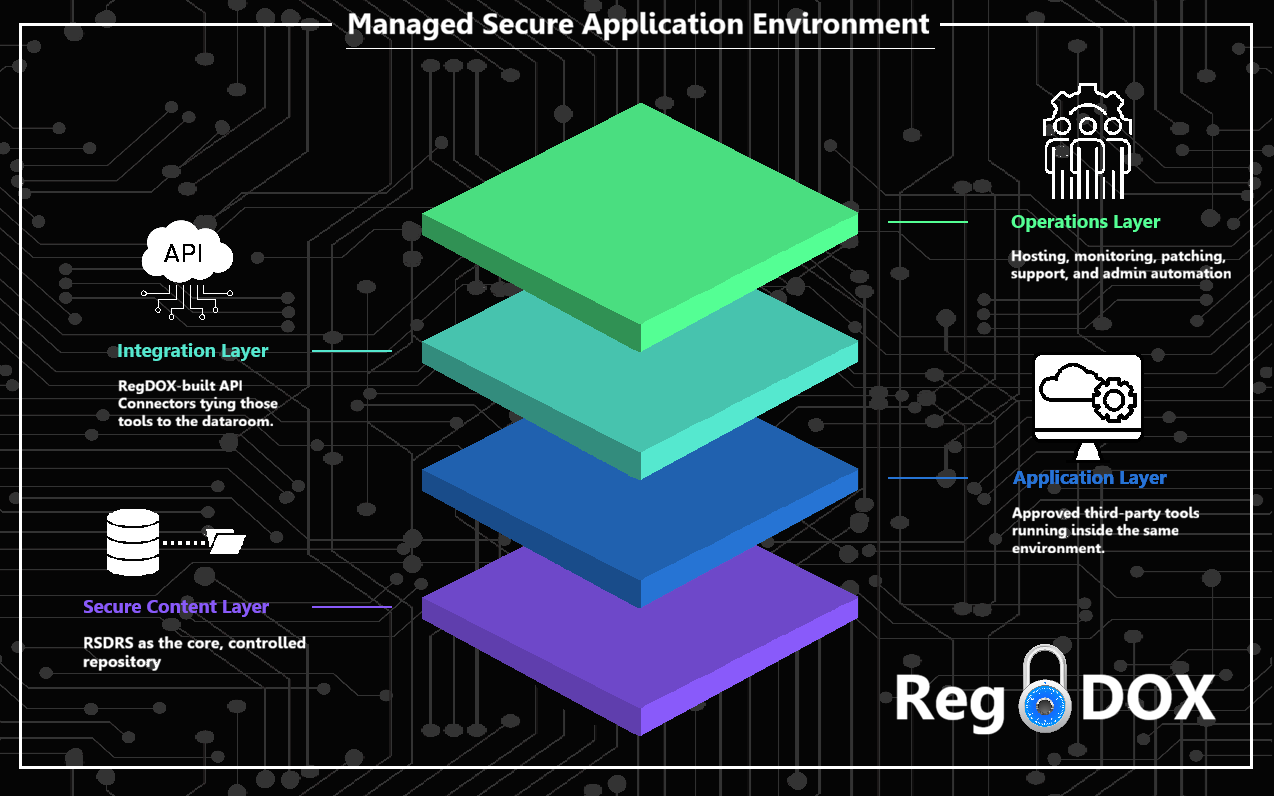
The CCE solution consists of four integrated layers:
- Secure Content Layer – RegDOX Secure Data Room Solution (RSDRS) as the controlled repository
- Application Layer – Third-party applications installed inside the same compliant environment
- Integration Layer – RegDOX-built API connectors enabling seamless data flow between systems
- Operations Layer – Fully managed hosting, monitoring, patching, and support
This layered architecture transforms secure storage into a fully integrated, compliant computing environment for managing sensitive data at scale.
Business Outcome


Security & Compliance
The organization ensures that CUI never leaves a controlled environment, maintaining strict compliance boundaries while achieving full audit visibility across all data rooms.

Operational Efficiency
Manual integrations and ongoing maintenance overhead have been eliminated, while administrative processes are streamlined through automation at scale.

Scalability & Workflow Enablement
The platform supports thousands of users and data rooms with standardized processes, enabling multiple business workflows to operate securely within a single environment without relying on external tools or data movement.
Ready to Secure and Simplify Your Sensitive Data Workflows?
Download the CCE Case Study Executive Summary
Explore a high-level overview of how RegDOX delivers secure, scalable solutions.
Free Consultation with RegDOX’s Compliance Team
Get expert guidance tailored to your compliance and security requirements.
Get a Demo of RegDOX’s CCE Enclave
See how RegDOX enables secure, compliant workflows in a controlled environment.
