
Why Ownership Questions Reveal Governance Gaps Sarah was preparing documentation for an upcoming compliance review…
The ITAR Compliance Checklist Every U.S. Exporter Needs in 2025
5.
The ITAR Compliance Checklist Every U.S. Exporter Needs in 2025
Why You Need an ITAR Checklist
ITAR compliance isn’t just about avoiding penalties. It’s about staying organized, proactive, and ready for audit. To begin with, maintaining compliance with the International Traffic in Arms Regulations (ITAR) is essential for any organization that handles defense-related products, services, or technical data. That’s why we’ve created a practical, easy-to-follow ITAR compliance checklist, a go-to resource designed to help your team align with ITAR requirements and reduce compliance risk across your operations.
Complete the form to receive the ITAR Compliance Checklist by email.
Whether you’re conducting an internal audit, onboarding new staff, or preparing for a compliance review, this checklist breaks down the core ITAR requirements into actionable steps. Moreover, it’s especially helpful for cross-functional teams that manage compliance across IT, legal, operations, and product development.
Importantly, even if your business isn’t exporting physical products, you may still be handling controlled technical data—making access control, encryption, and documentation just as important.
2025 ITAR Compliance Checklist
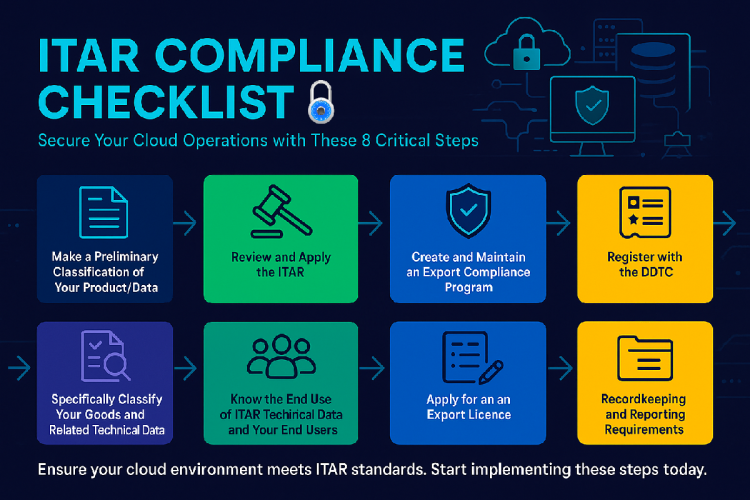
To make it easy to digest, we’ve visualized the eight essential ITAR compliance areas from the checklist into this infographic. These include foundational components such as classification, DDTC registration, licensing, access controls, and secure data handling—all aligned with NIST standards.
Whether you’re just starting or improving an existing program, this infographic serves as a quick-reference guide to ensure you’re on the right track.
Coming Up
In the next post, we’ll explore what happens when organizations fail to comply with ITAR & the penalties that follow, including fines, debarment, and criminal exposure.
About RegDOX
At RegDOX Solutions Inc., we help defense contractors and high-security organizations simplify compliance with ITAR, EAR, DFARS, NIST SP 800-171, and CMMC requirements. Our secure, cloud-based platforms combine end-to-end encryption, access controls, and audit-ready documentation to keep your data—and your contracts—safe.
Need help navigating evolving cybersecurity regulations?
Request a Compliance Demo
Or contact us directly at info@regdox.com
Click to rate this post!
[Total: 0 Average: 0]
Related Posts

This Post Has 0 Comments